
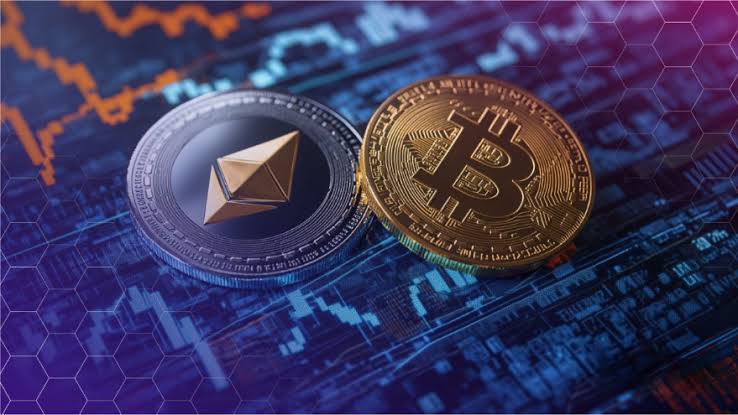
Exchanging Bitcoin (BTC) for Ethereum (ETH) isn’t simply a swap of one cryptocurrency for another, but a transition between two different blockchain development logics. BTC is often perceived as the foundation of the market, an asset for storing value and long-term holding. ETH, in turn, has become the infrastructure for applications, smart contracts, and entire digital ecosystems.
Therefore, exchanging BTC for ETH through an aggregator is rarely accidental. It’s usually a conscious redistribution of capital within a crypto portfolio, when the user wants to change the direction of capital within the cryptoeconomy rather than exit the market.
Why people swap Bitcoin for Ethereum
Bitcoin and Ethereum serve different functions, and this is precisely what makes exchanging them a logical asset management tool. Bitcoin is a digital reserve, while Ethereum is a platform around which many services are built.
The transition from Bitcoin to ETH is most often associated with practical reasons:
- Participation in the ecosystem of decentralized applications;
- Access to DeFi services and smart contracts;
- Crypto portfolio redistribution;
- Focus on the development of the Ethereum network;
- Using ETH as an operational asset;
- Diversification across different blockchains;
- Working with Web3 projects.
As a result, Ethereum is becoming not a Bitcoin replacement, but an expansion of user capabilities within the crypto world.
What are the differences between the roles of BTC and ETH?
Bitcoin was created as a digital currency system, characterized by a limited supply and an extremely simple structure. Its purpose is to securely store and transfer value without intermediaries. Ethereum took a different path. It became a platform for launching applications, tokens, and financial protocols. This has transformed it into a kind of infrastructure for the new digital economy.
The differences manifest themselves in key aspects:
- BTC is focused on storing value;
- ETH is focused on use in applications;
- Bitcoin has a more conservative development;
- Ethereum is actively updating and expanding its functionality;
- BTC is increasingly used as a reserve asset;
- ETH – as a tool for interacting with Web3;
- Different real-world use cases.
This is why they are often exchanged to replace capital.
What’s Important When Exchanging BTC for ETH
Although this exchange is considered one of the most liquid, the outcome of the transaction depends on more than just the market price. Technical and organizational details of the exchange are also important. Before converting, people typically consider:
- The current BTC to ETH exchange rate;
- Transaction processing speed;
- Bitcoin and Ethereum network fees;
- Availability of liquidity;
- Method for obtaining ETH;
- Exchange service stability;
- Network congestion at the time of the transaction.
Even small differences in terms can affect the final amount of Ethereum received.
How users approach this conversion
Unlike speculative transactions, exchanging BTC for ETH is often not an attempt to time the market. It’s more often a decision to reallocate assets within a portfolio. Therefore, users typically take a simpler approach, choosing the right moment and executing the exchange without complex strategies.
The behavior can be described as follows:
- part of the capital is transferred from BTC to ETH;
- the transaction is performed without active trading;
- focus on long-term asset allocation;
- minimizing the time spent on the process;
- prioritizing convenience over market analysis.
This makes the exchange more structured than speculative.
Electronic exchangers – what role do they play?
Electronic exchangers are used quite often because they eliminate the trading part of the process and focus solely on the conversion. The user doesn’t deal with orders or charts; they simply receive ETH in their wallet after sending Bitcoin.
This format is especially convenient when trading is not desired, transaction speed is paramount, and a simple exchange is needed that eliminates the need for market analysis. In this case, exchangers act as a technical layer between two major cryptocurrencies.